
Following My Ancestor Back to Norway
A family story of emigration, war, and returning to Norway generations later.
By Marla Peterson
In the summer of 2016, I stood on the Teigen farm in Marifjøra, a small village at the end of Sognefjorden in western Norway. From this place, my great-great-grandfather, Peder Pedersen Teigen, had left for America in 1861.
My interest in family history accelerated around that time. During the Syttende Mai celebrations in Westby, Wisconsin, the local historical society offered free genealogy sessions. I brought what little information I had and, after several hours of digging alongside a genealogist, left with the name of someone still living on the farm.

Westby sits in the Driftless Region of western Wisconsin, a region where many Norwegian immigrants settled in the nineteenth century.
I learned that Peder was born in 1840 in Hafslo parish in Sogn og Fjordane. He was the eldest of six sons and the first of three brothers who eventually emigrated to America.
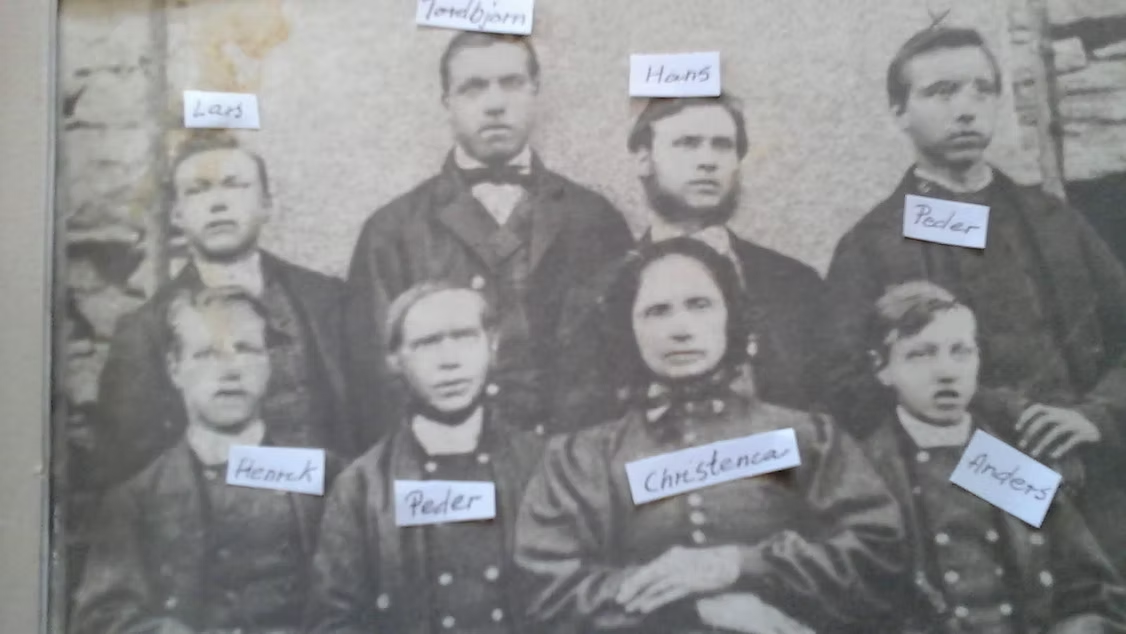
Much of what I know about the family comes from Norwegian parish records and the local bygdebok, the traditional farm and family history books that document generations connected to a particular farm.
On April 13, 1861, at the age of twenty-one, Peder left his home parish in Norway. The first shots of the American Civil War had been fired the day before at Fort Sumter. He was one of thousands of young Norwegians who left the country during the nineteenth century, many of them bound for the American Midwest.
Parish records show that he departed Hafslo that spring.

From there he likely traveled to Bergen. Based on the timing of the parish records and passenger lists from that spring, he may have been among the passengers on the ship Balder, which left Bergen on April 18, 1861 and arrived in Montreal two months later.
From Canada he would have continued south to Wisconsin, where many Scandinavian immigrants were settling.
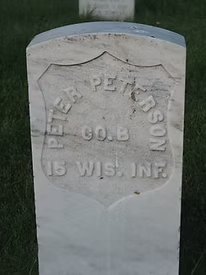
Only a few months after arriving in America, Peder joined the Union Army during the American Civil War. Enlisted under the name Peter Peterson, he joined Company B of the 15th Wisconsin Volunteer Infantry on October 16, 1861, an all-Scandinavian regiment.
The men of Company B called themselves the “Wergeland Guards,” in honor of the Norwegian poet Henrik Wergeland.
Peter began training at Camp Randall in Madison, Wisconsin in November 1861, just seven months after leaving Norway. In March 1862, after several months of training, he and his regiment left camp to join the war.
He served for three years, one month, and fifteen days before being mustered out of service in 1865.
After the war, Peter returned to Wisconsin and settled near West Prairie in Crawford County. This area is now widely known as part of the Driftless Region, where many Norwegian immigrants established farms in the nineteenth century.
There he married Britha Eriksdotter, known in America as Betsey Erickson. Together they farmed in Freeman Township and raised ten children, including my great-grandfather Erick.
In 1883 Peter became a naturalized citizen of the United States. As part of the process he formally renounced his allegiance to the King of Sweden and Norway, the monarch who ruled both countries at the time.
Like many immigrants of that era, he had crossed the ocean to begin a new life.
When I first visited Norway in 2016, I traveled to Marifjøra to see the original Teigen family farm.

There I met relatives who still live there today, descendants of Anders, one of Peder’s brothers who remained in Norway. I have returned to the farm twice since then and remain in regular contact with my Norwegian family.

Over time I found myself returning to Norway again and again. What began as curiosity about family history gradually became something more personal.
In 2021, after nearly twenty years working in public education in the United States, I decided to leave my job, give away most of my belongings, and take a one-way flight to Norway.
Shortly before leaving, I stopped at the Wisconsin State Capitol in Madison to visit the statue of Colonel Hans Christian Heg. Heg was a Norwegian American officer who commanded the 15th Wisconsin Infantry during the American Civil War.
The statue had recently been restored after being damaged during protests the previous year. Two days before leaving, I visited the statue and rubbed Heg’s right boot, not for good luck but for courage.
Today I am on a residency path in western Norway, not far from where my great-great-grandfather began his journey to America more than 160 years ago.
It has now been almost ten years since I first sat down at that genealogy table during the Syttende Mai celebration in Westby. What began as a simple question about a family name eventually carried me across the Atlantic.
When I stood on the Teigen farm in Marifjøra in 2016, I was looking back at the place where his journey began. A few years later, I crossed the same ocean in the opposite direction and began building a future in the landscape my great-great-grandfather once left.
About the author
Marla Peterson grew up in the Driftless Region of western Wisconsin, where many Norwegian immigrants settled in the 1800s. Her great-great-grandfather emigrated from Hafslo in Sogn og Fjordane to Wisconsin in 1861. More than 150 years later, she moved in the opposite direction and now lives in western Norway. She writes about genealogy, migration, and everyday life between two places on her blog Marla Goes North.
A big thanks to Marla for sharing her story with us. If you would like to share something about your genealogy research or a story about an ancestor, get in touch through the Contact page. See also my blog post Your story matters.Why Your Story Matters


